Sumba Journal
Sumba Megalithic Tombs & Stone-Pulling Ceremonies
9 min read
Sumba’s megalithic tombs are enormous carved stone graves — capstones the size of a small room resting on sculpted pillars — and they stand not behind museum glass but in the middle of living villages, where families still bury their dead beneath them. The finest examples stand at Anakalang and Pasunga in Central Sumba, the royal villages of Rende and Prailiu in the east, and Praijing, Ratenggaro and Wainyapu in the west and southwest. Sumba is also one of the last places on earth where new megaliths are commissioned, carved and hauled by hand in the stone-pulling ceremony known as tarik batu (tingi watu). This guide explains where to go, what the tombs mean, how the ceremonies work, and how to visit respectfully with your private guide in 2027.
What Makes Sumba’s Megalithic Tombs Unique?
Most megalithic sites in the world — Stonehenge, Carnac, the dolmens of Korea — are archaeology in the past tense. Sumba is the exception. Here, megalithic burial remains a living practice tied to Marapu, the island’s ancestral faith, in which the dead stay active members of the clan. A tomb in front of the family house keeps the ancestors close; the bigger the stone, the greater the honour and the standing of the lineage that raised it.
This is why archaeology in Sumba megaliths attracts researchers worldwide: it is one of very few places where scholars can watch a megalithic culture operate rather than reconstruct it from fragments. Tomb forms range from plain slab graves to full dolmens — four or six carved pillars carrying a single monolithic capstone — decorated with buffalo horns, horses, crocodiles, turtles and human figures that record the rank and deeds of the person resting below.
Where Are the Best Megalithic Tombs in Sumba?
Anakalang & Pasunga — Central Sumba’s Giants
The Anakalang valley, about an hour’s drive east of Waikabubak, holds the heaviest tombs on the island; the largest capstone here is estimated at roughly 70 tonnes and took hundreds of pullers to move. Neighbouring Pasunga keeps one of Sumba’s most photographed carved tombs, fronted by a standing stone portraying its noble occupants, with quieter Praigoli nearby. Our Central Sumba Tour pairs the Anakalang complex with Lapopu and Matayangu waterfalls in one unhurried day.
Rende & Prailiu — Royal Tombs of the East
In East Sumba, the royal village of Rende near Melolo lines up monumental tombs carved with turtles, crocodiles and shrimp — emblems of nobility — beside houses where some of the island’s finest ikat is still dyed and woven. Prailiu, on the edge of Waingapu, offers royal tombs and weaving looms within fifteen minutes of your hotel; both feature on our East Sumba Tour alongside Walakiri’s dancing mangroves.
Praijing, Ratenggaro & Wainyapu — West & the Kodi Coast
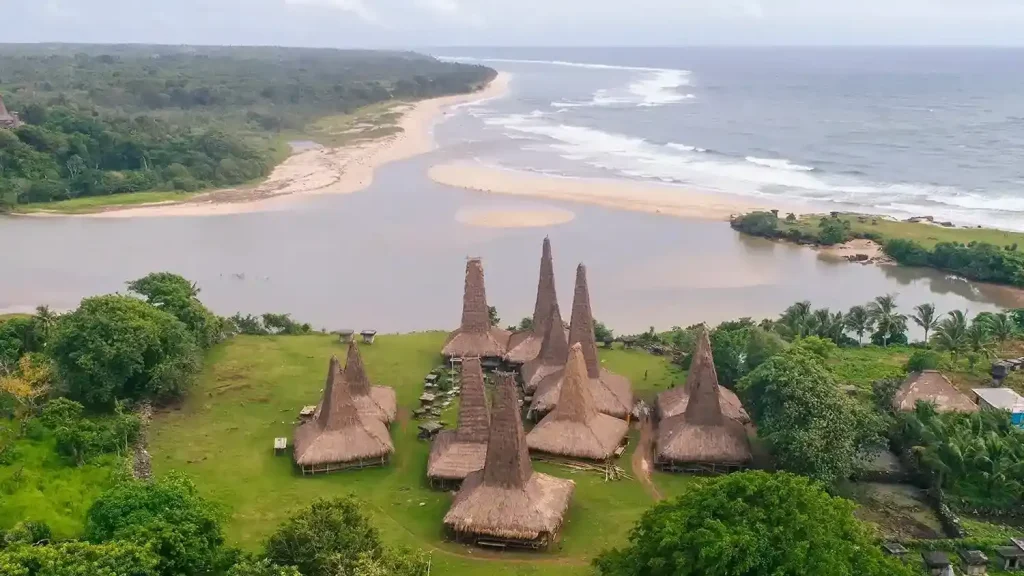
Praijing (Prai Ijing), the hillside village above Waikabubak honoured with an ASEAN Tourism Award in 2026, arranges its tombs in neat terraces beneath towering thatched roofs. Far to the southwest, Ratenggaro sets its megaliths on a grass headland above the Indian Ocean, framed by rooflines that climb about fifteen metres, with Wainyapu’s tomb field visible across the river mouth. These two coastal villages anchor our Southwest Sumba Tour, while Praijing is a highlight of the West Sumba Tour.
What Happens at a Stone-Pulling Ceremony (Tarik Batu)?
When a noble family commissions a tomb, the capstone is quarried, rough-carved, then hauled to the village on a wooden sledge — sometimes over several kilometres — by hundreds of clansmen pulling in rhythm to chants, drums and gongs. Rato, the Marapu priests, read omens and set the pace; betel nut is shared and offered at every stage; buffalo and pigs are sacrificed to feed the pullers and honour the ancestors. A single pull can draw in whole allied villages and consume weeks of preparation, which is exactly the point: the labour itself is a public display of the family’s alliances and rank.
There is no published calendar. Pulls cluster in the drier months, roughly June to October, but each is set by clan deliberation and Marapu ritual, never by tourism. It works like Pasola in that respect — confirmed by lunar calendar around February–March, and we track local announcements rather than promise dates. If one happens near your route, your driver-guide will hear of it days ahead through family networks, and we will rearrange your itinerary so you attend as an invited guest.
How Should You Behave at the Tombs?
Every tomb stands on clan land, and every village you enter is someone’s home. The protocol is simple when a Sumbanese guide walks ahead of you:
- Greet first, visit second. Your guide announces you to the village head, handles the customary donation or guest book, and — where offered — the betel-nut welcome; accepting graciously is appreciated.
- Never climb, sit or picnic on a tomb. These are graves in active use, not viewing platforms.
- Dress modestly, keep voices low near ritual houses, and ask before photographing people, looms or ceremonies.
- Are drones allowed in Sumba? Yes — Indonesia permits recreational flying under civil aviation rules, and the savannah scenery rewards it — but over villages, tombs and any ceremony, permission comes first — never fly over a tarik batu or funeral without explicit consent.
How Do You Get There & What Does It Cost?
Fly from Bali (Denpasar) to Tambolaka for the western villages or Waingapu for Rende and Prailiu — daily flights of about 1h15m. Guests booking a Sumba tour from Australia connect through Bali, often same-day. If fear of flying on small planes to Sumba holds you back, take comfort: these are modern turboprops on a short daylight hop, and the savannah approach is a quiet pleasure.
On the ground, a private car with an English-speaking local driver-guide runs from about USD 60–90 per day (August 2026 indicative). A focused 3D2N introduction to the megalith villages starts from roughly USD 300–550 per person, while our most-booked 4D3N — covering Ratenggaro, Praijing and the eastern tombs — runs from USD 390–700 per person, as of August 2026 and subject to season, mirroring the published rates of our parent operator’s 4D3N Sumba tour. Unlike quote-only agencies, we would rather you see the numbers before you write to us.
Bring rupiah in cash: check currency exchange rates for IDR before you fly and change money in Bali, as ATMs in Tambolaka and Waingapu are workable but few. Village donations are small notes; the price of coffee in Sumba cafes is refreshingly modest, and a glass of locally grown kopi Sumba in Waingapu is a ritual worth adopting. One health note guests often ask about — is malaria common in Sumba? It is present, and East Nusa Tenggara carries more risk than Bali, so talk to a travel-medicine doctor about prophylaxis, use repellent at dusk and sleep under nets or air-conditioning.
Beyond the Tombs: Slow Travel Ideas for 2027
The megalith villages reward unhurried travel, and many guests shape whole trips around that pace. Sumba for digital detox retreats is a genuine proposition — signal fades between villages, and nobody minds. You can add Sumba glamping near beach country on the Kodi coast, arrange Sumba horse rental with handler for a sunset ride below Ratenggaro’s headland, or extend into Sumba sailing and beach camping along the quieter bays. Travel lightly while you do: recycling initiatives in Sumba are still young, so carry a refillable bottle, take soft plastics back with you, and buy ikat directly from the weaving families beside the tombs — the most direct way your visit strengthens the culture you came to see.
Frequently Asked Questions
Are Sumba’s megalithic tombs still used for burials?
Yes. Megalithic burial is a living Marapu tradition: families still commission, carve and raise new tombs in front of their houses, and elders are interred beneath them today, which is why respectful conduct matters at every site.
Can visitors watch a tarik batu stone-pulling ceremony?
Yes, when one coincides with your trip. There is no public schedule — clans set dates by ritual deliberation, mostly June to October — but our local driver-guides hear announcements early, and we rearrange itineraries so guests attend by invitation.
Which village should I visit if I only have one day?
From Tambolaka, combine Praijing with Ratenggaro and Wainyapu for tombs, tall roofs and ocean scenery in a single day. From Waingapu, pair Rende with Prailiu for royal tombs and ikat weaving in half a day.
Plan Your Megalith Journey
Our advisors and driver-guides are Sumbanese; they grew up with these tombs, know the families who keep them, and plan your route around real village life rather than a checklist. Speak to our Sumba travel advisor on WhatsApp at +62 811-994-1919 or email sales@indonesiajuara.asia, and we will build your megalith route for 2027 — with every price in writing. Sumba Island Tour is operated with Indonesia Juara Trip, high-end local Sumba expertise. Part of Juara Holding Group — since 2015.
Keep reading
More from the journal.